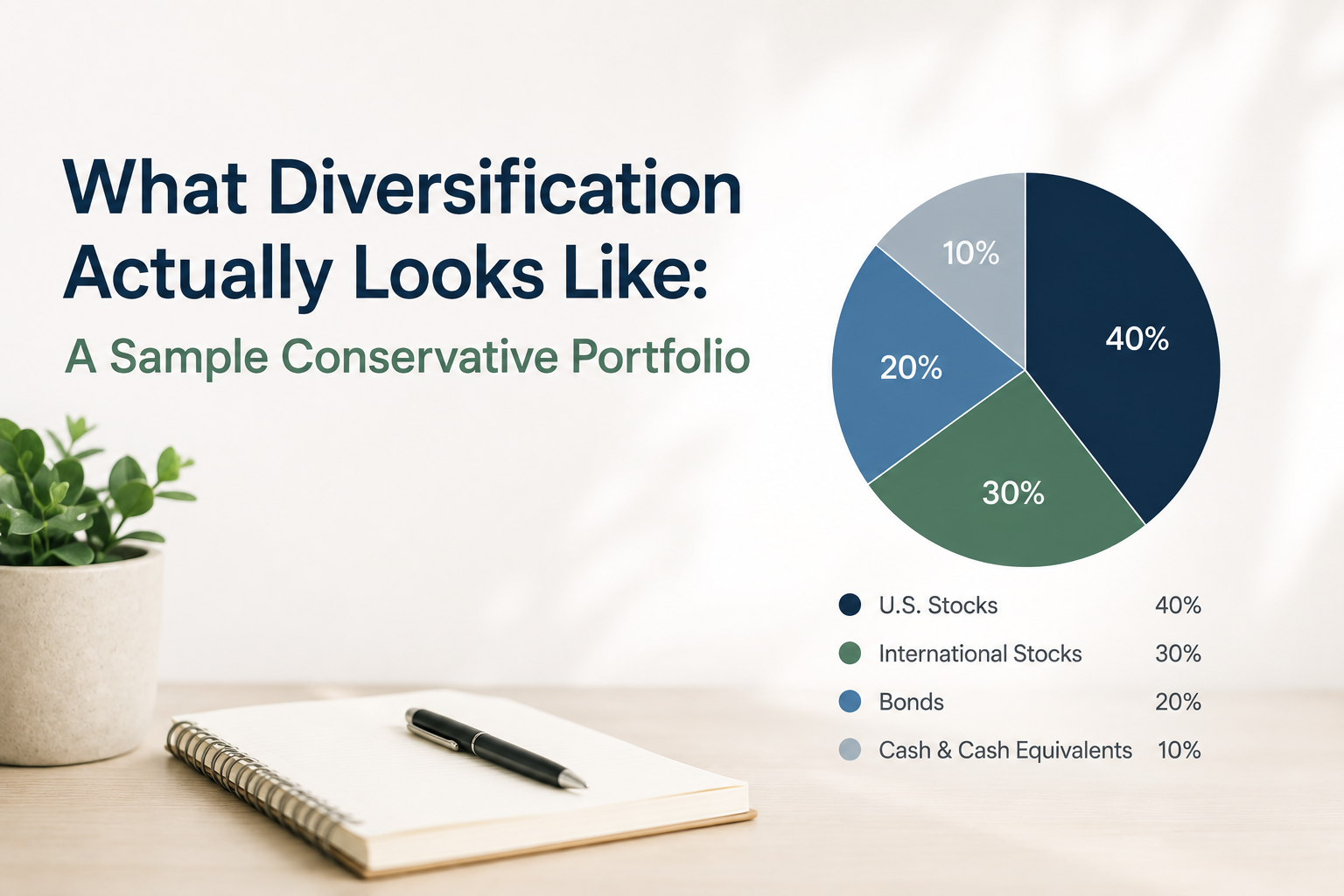
«Don’t put all your eggs in one basket» is the usual one-line summary of diversification, but it doesn’t explain how to actually build a diversified portfolio or why the mix matters. Here’s a real sample allocation and what each piece is doing.
The Investor Profile
Age 45, moderate risk tolerance, investing for retirement in about 20 years, with $50,000 already saved and $500/month being added.
A Sample Allocation
- 40% U.S. total stock market index fund — broad exposure to thousands of U.S. companies across sectors and sizes, the core growth engine of the portfolio
- 20% international stock index fund — exposure to companies outside the U.S., which don’t always move in the same direction as U.S. markets
- 30% U.S. bond index fund — lower expected returns than stocks, but historically less volatile, and bonds have often (not always) held up or gained when stocks dropped sharply
- 10% real estate investment trust (REIT) index fund — exposure to real estate returns without buying physical property, which tends to have a different return pattern than either stocks or bonds
Why This Isn’t Just «Buy Everything»
The point of diversification isn’t owning as many different things as possible — it’s owning assets that don’t all react the same way to the same event. Stocks and bonds, for example, have historically had a low or even negative correlation in many periods: when stock markets fall sharply due to recession fears, bond prices have often risen as investors seek safety, partially offsetting the stock losses in the portfolio.
What Happens in a Downturn: A Real Comparison
Imagine a year where the stock market drops 20%. A portfolio that’s 100% stocks would drop roughly 20% (before dividends). The sample 70% stock / 30% bond portfolio above, if bonds gained even 3% that year while stocks fell 20%, would see a blended loss closer to 13% — smaller, though not eliminated. Diversification reduces the severity of losses; it doesn’t prevent them.
The Trade-Off
The same diversified portfolio that loses less in a downturn also tends to gain less in a strong bull market, because the bond and REIT portions aren’t participating in the stock rally at the same rate. This is the fundamental trade-off: diversification smooths the ride in both directions, rather than maximizing gains.
Rebalancing: The Part Most People Skip
Over time, if stocks outperform bonds, the portfolio drifts — what started as 70% stocks might become 78% stocks after a strong year, quietly increasing risk beyond the original plan. Rebalancing back to the target percentages once a year (selling a bit of what’s grown, buying a bit of what’s lagged) keeps the risk level consistent with what was originally intended, rather than letting market performance silently reshape the portfolio.